
The return of the missing marten
"HOW DID THE PINE MARTEN RETURN TO CUMBRIA?" by John Hincks, Site Officer, Restoring Hardknott Forest, April 2026
The woods and crags of Lakeland have recently seen the return of an animal that was once a well-established resident of the area, the pine marten (Martes martes). This charismatic mammal was virtually extinct in England by the early part of last century, from the 1700s onwards loss of habitat and persecution led to population decline. There are several locations within Cumbria that reveal the former haunts of Pine Martens - seven “Mart Crags” (including one at Hardknott Forest) and five “Mart bields”. (Bield is Cumbrian dialect for “shelter”).
Pine martens belong to the mustelid family, which includes otters, stoats, polecats, weasels, badgers, and mink. They are present across Europe, with most of the UK population residing in Scotland. There are also small populations in Wales and the New Forest. In northern England they are also slowly recolonising Kielder Forest. They are now protected by law. Killing or harming, capturing or disturbing Pine Martens without a licence is a category 1 wildlife crime offence, and can result in fines and imprisonment.

Pine martens are woodland specialists
Pine martens are around 70cm from nose to tail tip, with males averaging around 2Kg in weight and females at 1.5Kg. Despite being excellent climbers (a pine marten’s ankles can rotate, allowing it to descended trees headfirst), they spend a lot of the time foraging on the woodland floor. Intelligent and resourceful, they are opportunistic and have a varied diet, small rodents make up 50% of this on average. They will also eat carrion during colder months, and at other times of the year frogs, invertebrates, fungi, small birds and fish. In the autumn, they gorge themselves on berries (rowan, bilberry and blackberry are favourites).
It is a misconception that pine martens are squirrel hunting specialists. Research analysing their scat (poo), has revealed that less than 5% of their diet consists of squirrel. They are active throughout the year and do not hibernate. Not having the physiology which facilitates a significant build-up of body fat to allow for extended periods of inactivity, pine martens find it necessary to feed at least once every few days.
They are predominately solitary, and territory size varies depending on suitable habitat. On average it is around 6km2 for a male and a smaller area for females. Females do not breed until their second year and have one litter of young per year in April, typically 2 to 4 kits, with the males playing no part in parental duties. The kits open their eyes after 35 days and are weaned by mid – May, and by autumn they are dispersing. Mortality in juvenile pine martens is high, and the majority do not make it past their second year. Foxes are the main predator, and as with all wildlife busy roads are a considerable danger. Seven years would be a particularly good age for a wild pine marten.
The slow reproduction rate and high mortality in juveniles means that a population can decline to a point whereby it is in a very vulnerable situation, and it cannot repopulate to sustainable and genetically viable numbers of individuals. This was the case in the Cumbria. With funding from Rewilding Europe (European Wildlife Comeback Fund boosts pine marten recovery in the UK | Rewilding Europe), and in partnership with the University of Cumbria, the University of Leeds, Forestry England and Natural England, also Graythwaite estate, The South Cumbria Pine Marten Recovery Project (SCPMRP) started work on a re-introduction in 2019, initially undertaking a feasibility study and the necessary research to obtain a licence from Nature Scot for a translocation. This involved community engagement and education events, habitat surveys, setting up trail cameras and small mammal trapping.
The staff of Restoring Hardknott Forest were delighted when the South Cumbria Pine Marten Recovery Project (SCPMRP) invited us to help them with this research. Initially we undertook small mammal trapping at Hardknott. This is necessary to determine the rodent population is at a level that would provide a sufficient food source, and we recorded good numbers of bank voles and wood mice. None of these were harmed in any way during the trapping process, as they are caught in a secure box containing food and straw, so the rodents basically got a night in a cosy apartment with buffet before we released them in the morning. Habitat surveys were also completed to record den site features, woodland connectivity and the fruiting plants that are important for pine martens in the autumn months.
Public engagement was a particular focus of the reintroduction feasibility study. If people were overall unsupportive of returning pine marten populations, then a translocation would not have taken place. A number of educational, public drop-in exhibitions were held in local village halls and community centres, and people were able to ask questions and share their thoughts on pine martens. Project staff visited local farms and estates in Cumbria to inform and listen to feedback from land managers and farming communities. The results of these surveys revealed the majority (80%) in favour of returning pine marten populations.
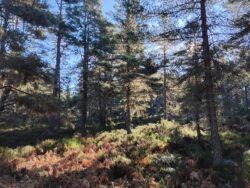
Caledonian pine forests are the main stronghold of the UK Pine marten populations
The SCPMRP started field work in the northeast highlands of Scotland in 2022, with permissions from Forestry and Land Scotland and a number of private estates to monitor the Scottish pine martens. It was important to figure out the population levels of the highland animals, as there needed to be sufficient individuals present that removing some to translocate to the Lake District would not cause a long - term negative impact. This monitoring was done using trail cameras and a device called a T - sniffer. The cameras were deployed in specific locations across a wide area and positioned in habitat the looked and felt “Pine Marteny”, facing the T-sniffer. This is simply a plastic pipe stuck in the ground and loaded with sweet treats to tempt any pine martens to investigate. Unable to resist the bait, the animal must stand up to get its prize, thus showing its bib (creamy white fur markings on the chest). The bib of a pine marten can be used to identify the individual animal, just like a dorsal fin of a dolphin or a human fingerprint. These images are then used to give a population density estimate. Scat transects were also mapped and walked, any pine marten scat found was collected and analysed in a lab for DNA, informing us further with regards to the numbers of animals in the Scottish forests.

Pine marten investigates T-sniffer
Once the data was collated the SCPMRP handed in a report to Nature Scot and a licence to translocate a maximum of 32 Pine Martens from northeast Scotland to Cumbria was granted. Trapping was conducted over two years, making up of two trips north in 2024 and 2025, for a duration of one month each trip. Autumn was the desired season to trap, as young pine martens are independent and dispersing. Also, food is plentiful at this time of the year, meaning the animals should be well fed and in good condition before being translocated, and there will be a good supply of food available for them upon their release. Trap sites were divided into zones over a large area to ensure that there would be varied genetics within the pine martens and within each trapping zone there was a maximum of four pine martens that could be captured to ensure that local populations would be conserved.
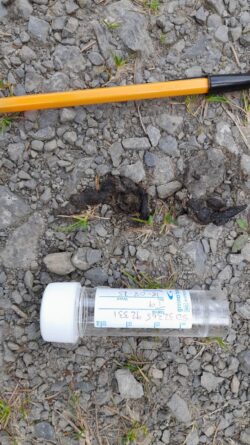
Scat samples were collected for DNA
The welfare of the animals was of paramount importance and traps were placed under cover with ample food and hay inside. These traps were set late in the day and checked early in the morning to minimise the length of time any captured pine marten would be inside. Trail cameras were installed and if discovering that we had been successful and had a caught a pine marten, the recordings would be examined for any signs of stress behaviour in the trap from the captured animal (in which case it would be at once released).
If a healthy looking and reasonably calm animal was trapped, then it was taken for vet examination. This was done after carefully administered anaesthetic (It would not be recommended to handle a fully awake and slightly annoyed pine marten). During a 15-minute process microchips were fitted and data was collected on size and condition, along with an overall health check. A radio collar was fitted to each animal, with a strap that is designed to deteriorate and fall off after a 12 month period. These radio collars have enabled the project team to track the movements of the pine martens that have been released in the South Lakes.
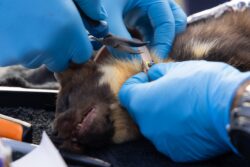
Radio tracking collars were fitted under anaesthetic
After the examination, the pine marten would then be transferred to a larger, more comfortable portable carry cage for a night to allow it to settle in a calm, quiet space and feed before the journey south. Two team members would share the drive, making several stops along the way to check on the furry passengers. The release pens were in remote areas of Grizedale Forest and Graythwaite estate and these were used to hold a pine marten for 24 hours so that it could feed up and take in the new surroundings before the pen door would be left open for it to go out to a new life in the woods of Cumbria.
The pine martens were translocated over the month-long trapping period in staggered numbers depending on when and how many were caught, (if any). Immediately after release, each individual was tracked using radio telemetry. Some of them did not travel particularly far from their release pen, but they can move a long way during the course of a night (16kms over 3 hours with one individual!). Most pine martens did not stop moving around for prolonged period as they sought to set up new territories and get their bearings, one female went from south to north lakes in a matter of days. But after this wandering time, they have found places that suit them to call a home.

Radio tracking pine martens in Cumbria
The females translocated in 2024 would have been pregnant at that time and since then there have been kits born in the Lake district. All this is credit to the South Cumbria Pine Marten Recovery Project (click the link for a YouTube video "Pine martens return to South Cumbria"), and the brilliant team of volunteers without whom all the hard work would not have been possible. There is still a lot of work to do, the monitoring will be ongoing, to help protect the welfare of the pine martens and also provide data regarding population numbers and their dispersal range. Eventually the radio collars will all have broken off the animals, but it is still possible to keep track of them using trail cameras and going out looking for poo (it smells quite sweet if you have a sniff). We were delighted to recently find a scat at Hardknott Forest and have captured a pine marten on one of our cameras (see this link). Den boxes have been placed in the forest, and hopefully one day they may be occupied by female with kits.
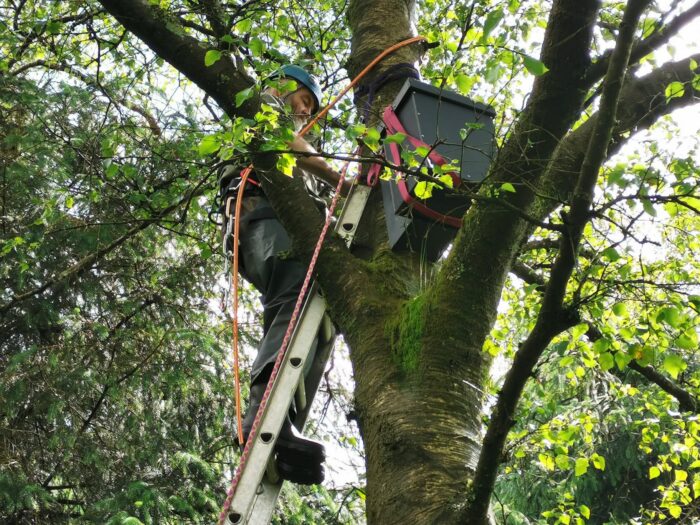
Installing a den box at Hardknott Forest
Further research is also underway to assess the impact that the pine martens may have on the squirrel population, and although more data is required to be definitive, there is already a correlation between pine marten presence and a decline in grey squirrel detections. There is strong evidence from previous research projects that pine martens have a significant impact on grey squirrel populations, and that where pine martens are present red squirrel number are robust and healthy. Grey squirrels did not evolve alongside pine martens as did red squirrels and are not as able to evade them as well as their smaller cousins can.
This spring, there will be new Cumbrian pine marten kits born in the woods, and if you are out driving late in the evening, keep an eye out for something unusual dashing across the road. It might just be one of these fantastic mammals, back in the landscape where they belong.
Further information:
General information on the pine marten can be found here:
Pine Marten (Martes martes) - Woodland Trust
For more info on squirrels and pine martens click the following links:
Indirect effects of pine marten recovery result in benefits to native prey through suppression of an invasive species and a shared pathogen (2023)
Red Squirrels - Help From a Predator (Galloway Glens)
The enemy of my enemy is my friend: native pine marten recovery reverses the decline of the red squirrel by suppressing grey squirrel populations | Proceedings B | The Royal Society
Population crash in an invasive species following the recovery of a native predator (2014)
A recent podcast (April 2026) by Cumbria Wildlife Trust interviewed Mic, Julia and Jon from the South Cumbria Pine Marten Recovery Project, and can be found here.
To see more pine marten action (three of them in confrontation with a fox!) see this link.
South Cumbria Pine Marten Recovery Project are on Instagram here and Facebook here.